
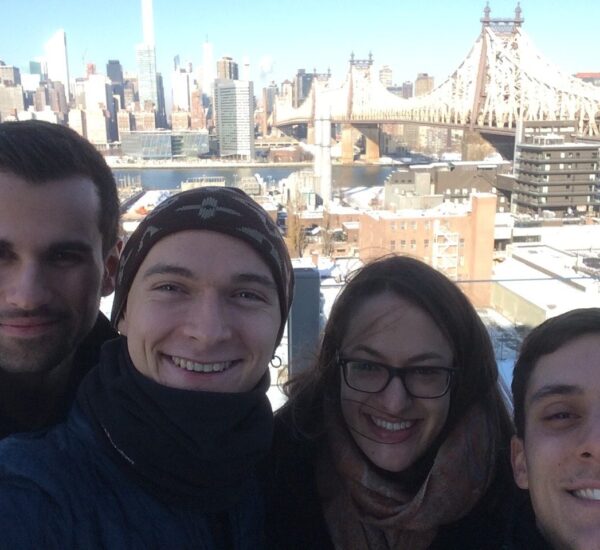
Team Minerva won the Global Case Competition in New York
It all started in April 2017, when four students from ETH Zurich and the University of Basel signed up for a Local Case Competitio...

Stories from around the Globe





In November 2025, during the final edition of the long-standing public dialogue series Treffpunkt Science City at ETH Zurich, I had the opportunity to listen to a deeply personal and moving talk by Daniel Albertin, the mayor responsible for the small mountain village of Brienz in the canton of Graubünden. His story stayed with many in the audience that afternoon. Today it resonates even more strongly. The residents of Brienz can finally return to their homes after more than a year of evacuation. The danger of a major rockfall has eased for now. It is a moment of joy for the community and for the authorities who carried this responsibility.

Albertin opened his talk with a simple yet powerful question: What does a mayor do when his entire village must leave its homes?
Brienz is a small village of around 80 residents in the Swiss canton of Graubünden. For generations the mountain above the village moved slowly. A few centimetres per year felt normal to those who lived there. Monitoring began around the year 2000 to observe the slope. The situation changed in 2017 when the speed of the landslide suddenly increased. Movement that once measured six or seven centimetres accelerated to forty centimetres per year. Later it reached more than two metres annually.
Scientists and authorities realised that something unusual was happening. Beneath the mountain lies a massive sliding layer around 150 metres deep. Millions of cubic metres of rock move slowly across this surface. Over time, measurements, drilling projects and geological studies helped experts understand the scale of the phenomenon.
Researchers from ETH Zurich played an important role in analysing this complex situation. Using advanced computer simulations and hazard modelling, scientists helped authorities better understand how the mountain might behave and what risks the village could face.
Still, knowledge does not remove uncertainty. It only helps people prepare.

Albertin described the moment when theory turned into reality. In 2023 authorities ordered the first evacuation of Brienz. Residents had to leave their homes within a strict deadline. The mayor walked through the village with local firefighters to confirm that everyone had gone.
A place filled with familiar faces suddenly felt empty. Closed shutters replaced daily life. For Albertin it was one of the most difficult moments of his public service.
A massive rockfall soon followed. Nearly two million cubic metres of debris rushed down the slope and stopped about fifty metres before the village school building. The evacuation had been the correct decision.
Scientific modelling helped guide these critical decisions. Jordan Aaron, an expert in engineering geology at ETH Zurich, ran thousands of simulations using a computer model he developed to assess how far and how fast a potential rockfall could travel. The results were incorporated into the risk assessment used by authorities in Graubünden and the municipality of Albula/Alvra when deciding whether evacuation was necessary.
A second evacuation began in 2024 as the situation remained uncertain. Residents lived away from their homes for more than a year. Some families found temporary housing elsewhere. Children moved to different schools. The community learned to live with waiting.
Throughout the crisis, cooperation between scientists, engineers and local authorities proved essential. Monitoring systems track the movement of the slope day and night. Sensors measure ground displacement and provide early warning if conditions change.
Another important contribution came from the research of Johan Gaume, professor of Alpine Mass Movements at ETH Zurich and the WSL Institute for Snow and Avalanche Research SLF. Together with his team, Gaume developed simulation software to estimate how far landslides and rock avalanches could travel. Shortly before the major rockfall in 2023, his team produced a blind prediction of where the sliding mass might come to rest. When the event occurred, the outcome closely matched the model’s forecast. The result provided rare empirical confirmation of the model’s accuracy.
Such research highlights how scientific expertise can support communities facing natural hazards. Data, simulations, and field observations help decision-makers evaluate risks and prepare for events that cannot be controlled but can sometimes be anticipated.
Albertin spoke with great respect about the role of research and scientific advice. Experts from universities and geological institutes worked closely with cantonal authorities and the municipality.
A major technical solution also emerged. Engineers constructed a drainage tunnel designed to reduce water pressure inside the mountain. Early results show that the movement of the landslide has slowed significantly. What once moved more than two metres per year now moves only a few centimetres.
Even so, Albertin emphasised caution. Technical structures can stabilise a slope for decades or perhaps longer. No solution can control nature forever.
One of the most sensitive questions concerns the future of the village. Some residents want to remain in Brienz and rebuild their lives there. Others prefer to start again somewhere else.
Authorities therefore created an additional option. Residents who do not wish to return permanently can move to a new location with financial support before disaster strikes. This preventive relocation model recognises that safety and peace of mind mean different things to different families.
Albertin explained that both choices deserve respect. Those who stay must feel that their home still has a future. Those who leave must receive support and dignity in their decision.
Today the story of Brienz enters a new chapter. Geological assessments show that the immediate threat of a major rockfall has decreased. The movement of the slope has slowed to millimetres per year. Authorities have lifted the evacuation order.
For many people the moment is emotional. Some homes reopen after months of silence. Others remain closed for now while families consider their next steps. Life does not return overnight. Communities need time to rebuild routines, restore services and rediscover the rhythm of daily life.
Albertin described it as a day of joy for the people of Brienz and for the authorities who guided the village through years of uncertainty.
The story of Brienz offers lessons far beyond one Alpine valley.
During his talk, Albertin spoke with honesty about uncertainty, responsibility and hope. Now, as the village opens its doors again, those words feel even more meaningful.
For the people of Brienz, the mountain remains part of daily life. Yet today the village breathes again. And that alone is a reason to celebrate.
Watch the talk below in German:
