When Johan Speaks, You Listen
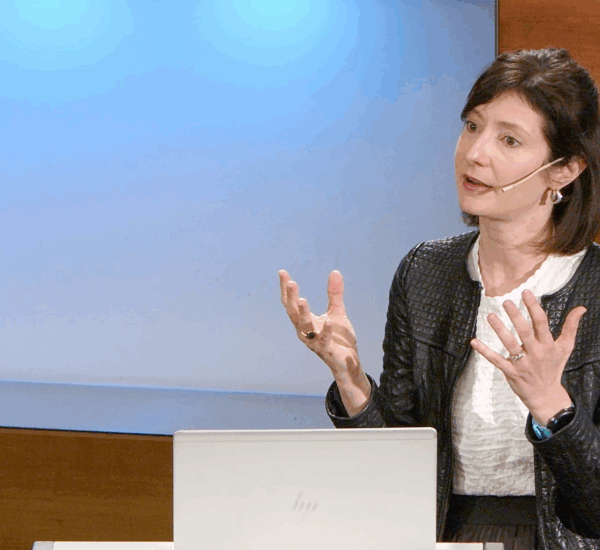
May 14, 2026It’s not every day you get to meet in person a fellow Swede who happens to also be a rockstar in the world of climate science, and a generally lovely human being. Having witnessed him in action previously in grand speaking arenas including TED and the World Economic Forum, it was a bit surreal to find myself on stage next to him, co‑moderating our Global Lecture on “Taking the Pulse of the Planet.” I am talking about none other than the legend that is Johan Rockström, the man behind the Planetary Boundaries Framework and co-creator of the recently launched Planetary Health Check. My colleague Chris Luebkeman and I were joined by ETH Assistant Professor Millie Chapman to hear from and talk to the man himself on the occasion of the inaugural Climate Week Zurich.

Here are the most important things he had to say in an hour that flew by and was by no means enough to go through everything that needed to be said on one of the key topics of our time.

We are living in the Anthropocene, a new geological age in which human activity fundamentally shapes the Earth system. Humanity and nature are now fully intertwined, co-evolving across planetary scales. This means that the stability of our societies is inseparable from the stability of the Earth’s life-support systems.
That stability is increasingly under pressure. Already today, with an increase by around 1.4°C since the pre-industrial era, extreme events are already disrupting lives and livelihoods worldwide. Beyond this, risks accelerate non-linearly: tipping points are hard-wired into the Earth system, and crossing them could trigger cascading feedback loops. This raises the possibility of a “hothouse Earth” trajectory well beyond the 2-3°C pathway currently projected, and ultimately beyond conditions in which modern societies can function.

These dynamics point to a deeper issue: the erosion of Earth’s resilience. Systems such as the Atlantic Meridional Overturning Circulation (AMOC) illustrate how destabilisation could produce profound and uneven regional impacts, while also feeding back into the global climate system. Importantly, these processes are interconnected: disruptions in one part of the Earth system amplify pressures elsewhere.

The Planetary Health Check provides the clearest scientific diagnosis to date. It tracks the state of nine critical Earth system processes, the “vital organs” that regulate stability and resilience, and shows that seven of nine planetary boundaries have now been breached, with pressures continuing to intensify. These boundaries function as guardrails for a safe operating space: once crossed, the Earth system moves into a zone of increasing risk, where tipping points, irreversible change, and loss of resilience become more likely.

What emerges is a stark but actionable insight: the planet’s “vital signs are flashing red”, yet the framework also shows where intervention is possible. Because these systems are tightly interconnected, stabilising the Earth system requires coordinated action across climate, biodiversity, land, water and pollution; not in isolation, but as part of a whole-Earth approach to staying within a safe operating space for humanity.

Millie Chapman brought in the decision-making dimension linked to the issues highlighted by Johan to the fore, by sharing her work at the Environmental Policy Lab of ETH Zurich. She examines how policies, institutions, and digital technologies shape outcomes for people and ecosystems. The work is structured in 3 focus areas:
Cooperation across scales: understanding what drives coordinated environmental action across actors, sectors, and governance levels.
Decision-making under uncertainty: designing robust, data-informed strategies and policies that remain effective despite complex ecological and social uncertainty.
Justice in an algorithmic era: examining how data and digital tools shape environmental decisions, with a focus on fairness, accountability, and bias.
Her point was that how decisions are made matters; the information decision-makers have to hand, on which to base their decisions, is the key to them developing effective and equitable strategies to meet global biodiversity targets. Data and algorithms can potentially reshape our management of environmental systems, and AI can help us move towards more sustainable and just futures in the context of environmental justice.
The well-attended event could have gone way past the scheduled hour, as was highlighted by the large number of poignant questions from the audience we did not manage to get to at the end. We closed the evening with a touch of optimism to add to the sense of urgency. Climate Week Zurich is a nice example of the local community getting together with global representatives from business, research and policy to accelerate climate impact in everyday life. Our event was a fitting addition to the inaugural schedule of activities taking place around the city, illustrating ETH Zurich’s commitment to sustainability.

Check out the pictures from the event here: Meet ETH Flickr
I hope this glimpse encourages you to come to a future event. I find that with our Global Lecture Series, we begin a new journey every time, giving ourselves pause to reflect on key topics on the global agenda and learning from individuals with remarkable clarity and foresight. I invite you all to come and join us! The next event will be on 10 September on the topic of research, with Nature’s Magdalena Skipper and ETH Zurich’s Annette Oxenius.